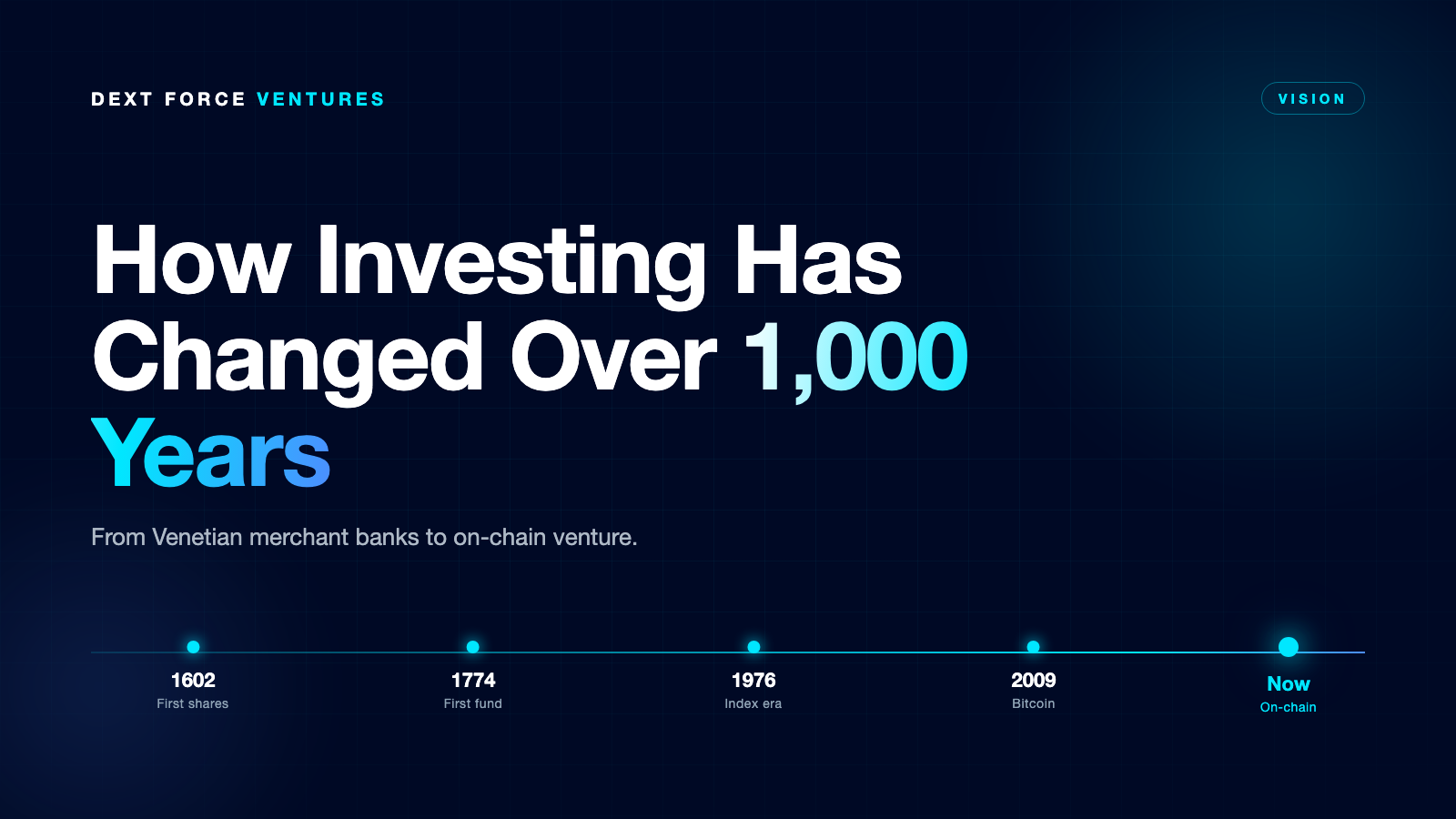
Investing feels like a modern invention. Charts, tickers, apps, tokens. It is not. The instruments change every few centuries, but the goal has stayed the same for a thousand years: take idle capital, put it to work, and share in what it builds.
What actually changes is who gets to play. Every major leap in finance has done the same three things. It pooled risk so no single person carried it alone. It lowered the barrier so more people could take part. And it widened ownership so the returns reached further than the room where the deal was struck.
Trace that pattern across a millennium and something useful happens. You stop seeing crypto as a break from history and start seeing it as the next entry in a very old ledger.
The merchant era: finance for the few
A thousand years ago, moving money was harder than moving goods. Gold was heavy, roads were dangerous, and lending at interest was frowned upon across much of Europe. Over the next few centuries, the workaround came from the merchant cities of Italy.
By the 1400s, houses like the Medici had built cross-border banking on the bill of exchange, a paper promise that let a trader deposit florins in Florence and collect the equivalent in London or Bruges. It was credit, foreign exchange, and settlement rolled into one, centuries before any of those words existed.
It worked, and it made a handful of families extraordinarily powerful. But access stopped at the edge of that world. If you were not a merchant, a noble, or a bank, capital markets simply did not include you.
1602: the year ownership got split into shares
The first real widening came from Amsterdam. In 1602 the Dutch East India Company, the VOC, needed enormous sums to fund voyages that might take years to pay off, if they returned at all. So it did something new. It sold its ownership to the public in tradable shares, with no set minimum, open to ordinary Dutch citizens.
To make those shares liquid, the Amsterdam Stock Exchange was born alongside it. Now a baker or a widow could own a slice of a global trading empire and sell that slice to someone else whenever they wanted.
This is the invention that everything after it copies. Risk pooled across thousands of strangers. Ownership sliced thin enough for regular people to hold. A market to trade it in.
Four hundred years later, we are still living inside that idea.
1774: diversification arrives for the small investor
Owning one share of one company is still a gamble. The next leap came, again, from a Dutch broker. In 1774 Abraham van Ketwich pooled money from many small investors into a single fund spread across dozens of holdings. He called it Eendragt Maakt Magt, "unity makes strength."
It was the first mutual fund. The pitch was simple and it has never changed: most people cannot afford to build a diversified portfolio on their own, so pool together and let the basket absorb the shocks. That instinct ran straight through the twentieth century and became the default way ordinary households touched the market.
1976: the cost of access collapses
By the 1970s, funds were everywhere, but they were expensive and most of them quietly underperformed the market they were trying to beat. John Bogle looked at that and asked a heretical question. Why try to beat the market at all? Why not just own it, cheaply?
In 1976 Vanguard launched the first index fund for everyday investors. It did not chase winners. It held the whole market and cut fees to the bone. Critics mocked it. Today indexing is the largest force in public markets, because it did the one thing that compounds hardest over time. It removed cost as a barrier.
The access era: friction goes to zero
The last stretch of the twentieth century attacked a different barrier: getting in at all. Discount brokers stripped away the expensive middleman in the 1970s. The internet put a trading terminal on every desk in the 1990s. By the 2010s, commission-free apps put one in every pocket.
Each step made the same trade. Less friction, less cost, more people at the table. A teenager with a phone now has cleaner access to markets than a Wall Street professional had in 1980. That is not a small thing. It is the whole thousand-year pattern, accelerated.
The on-chain era: markets that never close
Which brings us to now. In 2009 Bitcoin introduced ownership that no bank or government issued or controlled. Ethereum turned that into a platform where the market itself could be written as code. Decentralized finance rebuilt lending, trading, and settlement as open software that anyone, anywhere, can use without asking permission.
Look at what that actually changes, measured against everything before it:
- The exchange never closes. No opening bell, no settlement delay, no weekend. Markets run every second of every day, globally.
- The barrier is a wallet, not a broker. Someone with a phone and no bank account can hold, send, and invest. The permission layer is gone.
- Ownership is programmable. Shares became tradable in 1602. On-chain, ownership can also carry rules, rights, and logic that execute themselves.
- Real assets are moving on-chain. Funds, credit, treasuries, and private markets are being tokenized, dragging the old world onto the new rails.
Strip away the noise and the memes, and you find the exact same move the VOC made in 1602, the same move Van Ketwich made in 1774, the same move Bogle made in 1976. Pool the risk. Lower the barrier. Widen who owns the upside.
Why this is the thesis at DEXT Force Ventures
We did not choose crypto because it is loud. We chose it because it is the current chapter of a story that has paid out for a thousand years, and it is early.
"The investing landscape has changed completely over the last thousand years. Traditionally it was gated, open only to accredited, high-net-worth individuals. Now the playing field is fair: anybody with Wi-Fi can get involved and take a piece of the pie."
Wael Rajab, DEXT Force Ventures
Every generation had its builders. The Italian bankers, the Dutch merchants who wrote the first prospectus, the fund pioneers, the founders who put a market on the internet. They were not betting on a gadget. They were building the rails that let more people participate in the growth of the world.
That is what we back. As the investment arm of DEXTools, DEXT Force Ventures partners with the teams building the next set of rails, the infrastructure, the protocols, and the products that carry this pattern into its on-chain era. We help them get to a public listing and beyond, because we have read the ledger and we know how this story tends to reward the people who show up early and build.
A thousand years of finance keeps teaching the same lesson. The winners are rarely the ones who guard access. They are the ones who widen it.
That is the side of history we are investing in.
Written by Blockchain Academics.